



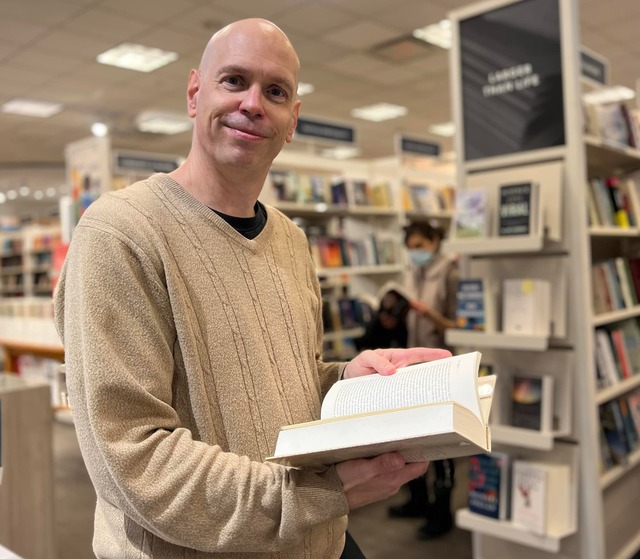
 Journalist and author Jeff Pearce. (Courtesy)
Tadias Magazine
By Tadias Staff
Published: January 18th, 2026
TADIAS — Jeff Pearce, the Toronto-based journalist and author whose work on Ethiopia has previously been featured in Tadias, returns to familiar ground with a new novel that moves beyond reportage and into fiction.
Pearce is best known to Tadias readers for Prevail: The Inspiring Story of Ethiopia’s Victory Over Mussolini’s Invasion, a nonfiction work built around rarely told, deeply personal accounts from the war—stories we described at the time as each “worthy of a big screen movie.” A few years ago, he also brought out The Gifts of Africa, which championed the continent’s vast intellectual legacy which the West has largely ignored. With this latest book, Pearce shifts form while remaining engaged with history, memory, and the country’s enduring global resonance.
The novel blends historical grounding with speculative elements, a combination the author himself has described as fantasy fiction. Yet at its core, the book reads as historical fiction—using imagination not to escape the past, but to reexamine it from a different angle.
Rather than presenting place as backdrop or abstraction, the novel treats it as active and consequential. History is not frozen in time; it echoes forward, shaping choices, identities, and futures in ways that feel both intimate and quietly unsettling. Pearce’s background as a journalist is evident in the texture of the world he builds, even as fiction allows him to explore questions that facts alone cannot fully answer.
For readers familiar with Prevail, the novel represents a clear evolution. Where Pearce’s earlier work documented real lives shaped by invasion and resistance, this new book asks what history might still be doing to us persistently, and often out of view—long after the headlines have faded.
It is a novel that invites curiosity rather than certainty, and one that continues a conversation between history, place, and storytelling that Tadias has long found worth following.
Q&A with Jeff Pearce
TADIAS: You’ve written extensively about Ethiopia through nonfiction. What made you turn to fiction — and specifically this story — now?
Jeff Pearce: I think I finally had the confidence to tackle the country in fiction. It’s been tremendously encouraging and even humbling to have many Ethiopians like what I do, whether it’s Prevail or my reportage, or my history videos—and they tell me so. They’ll also tell me when there’s something they think I should do better or give more attention. I like to think—at least I hope—that I’ve earned their trust. Ethiopia is unique, and to use its history in a fictional manner, you really need to prove you understand it through nonfiction first, or at least I felt that.
When it comes to this story specifically, it was inspired by outrage. I am so sick and tired, as I’m sure many people are, of the relentless lies being spewed online about Ethiopian history. It got me thinking: Okay, if they’re going to pull these stunts, why not hide the truth in my own “big lie?” A sprawling narrative that entertains but can also make you think. With history, you can only interpret from the facts—you can’t deviate. You work with what’s there. But with fiction, you get to create the whole world, and you can steer it to the lessons you want to impart.
TADIAS: You’ve described Sabeshya as fantasy fiction. How do you think about genre when history plays such a strong role in the novel?
JP: Well, I’m also close to finishing a new nonfiction history of the Ethiopian Empire. It’s been delayed by a few logistics, but it’s almost done. And when you study Ethiopia’s history, especially the Zemene Mesafint, it reads like you’re watching a Game of Thrones episode. You’ve got poisonings, you’ve got battles and feuds and intrigue. It’s truly amazing. But I thought, why limit myself? So my nonfiction history book will offer the facts, while Sabeshya springboards from those incidents and goes in different directions.
For me, genre writing is familiar turf. I wrote romantic thrillers in Britain under different pseudonyms. My novel, The Karma Booth, is a sci-fi novel. You get structure with genre fiction. Your detective is after the bad guy. Your spaceship takes the characters to another world. A white Western reader might pick up Sabeshya and really like all the double-crosses, the sword fights, etc., but an Ethiopian or a reader from another part of Africa hopefully enjoys the book on a deeper level, which is what I intended.
TADIAS: How did your background as a journalist shape the way you approached imagination, speculation, and storytelling in this book?
JP: I think my reporting on the war changed me forever (the war between Ethiopia and the Tigray People’s Liberation Front). With different colleagues, I saw camps for internally displaced persons. I met soldiers and ordinary Amhara farmers trying to protect their land. I walked through a field of corpses. I met individuals who had been brutalized and raped. I reported on the Mai Kadra massacre.
Fantasy fiction, like the kind I used to love (and still love), in Michael Moorcock’s sword and sorcery novels—all that’s pure escapism. Now Moorcock’s really good. But as far as I know, he’s never been near a real war. The smell of decomposing bodies is something you don’t soon forget.
At the same time, I hate the Western journalistic habit of treating Africans like interchangeable props of “suffering.” When you see the war photographs of Jemal Countess, for instance, the Ethiopians in these shots still have their dignity, their individuality. I want to write both history and fiction like that.
All these big fantasy novels deal with what’s known in the trade as “world building,” but Sabeshya explores world crumbling. What’s it like to be stuck in a refugee camp. The aftermath of battle. I consciously chose to make my hero Dawit a physician because you automatically have ethical issues built in. There’s a scene I’m very proud of—well, I don’t want to give any plot spoilers—where he has to pivot away from being a warrior to being a doctor. And you get the enormity of what he’s dealing with, what haunts his soul. He’s not out there for conquest, he wants to rescue his people and realizes the only way to save his people is to rescue and heal his whole nation.
TADIAS: For readers familiar with Prevail, what do you hope feels familiar in Sabeshya — and what do you hope surprises them?
JP: I think right now the themes of the novel are very timely for Ethiopians whose current events are getting mostly ignored by the West, which only likes to check in now and then when its news operations need a new thrill. And again, not to give things away, but as you know, the way Dawit’s war is portrayed by his world’s version of “the West” will be very familiar to readers!
Fans of Prevail tell me they love how that book read like a novel, and I very deliberately took a novelistic approach for that book. I throw the reader for Sabeshya right into the action soon after giving them a brief lay of the land. But more importantly, I think readers appreciated a story told mainly from the perspective of the Africans who lived it, not the Westerners who showed up and always were thinking of their own interests first.
One of my favorite novels of all time is Shogun. It’s a wonderful yarn about medieval Japan, and it’s a brick of a book. But our guide and our hero is this white English pirate, Blackthorne. Well, you don’t need that in Sabeshya, and I wouldn’t want that. I have my own kind of “Blackthorne,” but what I have happen to him makes a point about the West blundering into situations it doesn’t even try to understand.
You know, I’ve given Shogun to friends, and I’ve had one arrive at a party, mad as hell that a character died! I had another friend break down in tears on a bus over that same fictional death. That’s the power of fiction, that’s how good it is. I want people to get that emotionally moved by what I write. I hope they cheer Dawit on, I hope they love Enoch and Welansa, and they wish they could rush out and hurt the villains.
As for surprises… Well, I hope readers like the little touches, even if Sabeshya is not really Ethiopia. And I think anyone really familiar with the history will be pleasantly surprised by how close the novel really is to the truth!
TADIAS: Is there anything else you would like to share with our audience about the book, upcoming projects, etc?
JP: I just want to assure those who have been asking that yes, I hope to have the full history of the Ethiopian Empire out soon. It’s taking so long because I’m trying to make it as rigorously researched and factually accurate as possible, and that takes time.
I’m also trying to revive a project about Haile Selassie. It won’t be a biography because Asfa-Wossen Asserate has already written the best bio you can get out there. It won’t be a novel because Maaza Mengiste (author of The Shadow King) could do that so much better if she wants to and could kick my ass from here to Manhattan with her literary skills. I want to try something creatively different.
There’s a lot to explore with the emperor, and of course, that piece of work—when it finally gets done—will be controversial because you have those who love Haile Selassie out of all proportion to his human merits and failings and those who still believe the propaganda lies about the famine, about his exile, and choose to hate him. But I’ve been incredibly lucky to have known several people who knew the actual man himself, those who keep a proper perspective. And I’ve tried to do my homework.
I would even consider returning to Sabeshya and writing a sequel or prequel with new characters, but first I want to see how the novel sells and if it resonates with people. I hope it does.
TADIAS: Thank you, Jeff, and best wishes from all us at TADIAS!
—
You can find Sabeshya in paperback on Amazon.
Join the conversation on Instagram, X and Facebook.