



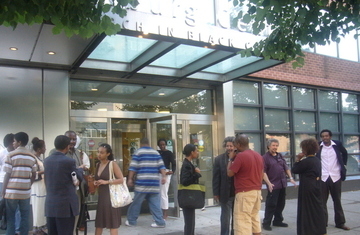
 At NYC's Schomburg Center for Research in Black Culture on Sunday, June 22, 2008. (Photo: Tadias )
Tadias Magazine
Events News
Published: Monday, June 23, 2008
New York (TADIAS) – This past Sunday, at Harlem’s Schomburg Center for Research in Black Culture, a panel discussion entitled “Ethiopia: The Three Faiths” attracted a diverse and large audience. The event hosted by Beta Israel of North America foundation began with cultural dances from the Indian subcontinent and an Ethiopian dance troupe called Keremela.
The panel included Dr. Ephraim Isaac, Director of the Institute of Semitic Studies at Princeton University; Dr. Ayele Bekerie, Professor of Africana Studies at Cornell University, Dr. Said Samatar, Professor of African History at Rutgers University; and Dr. Yohannes Zeleke, an archaeologist, anthropologist, and historian as well as the former curator of the National Museum of Ethiopia.
Dr. Zeleke shared information regarding the recent archaeological findings in Axum including the unearthing of the Queen of Sheba’s palace and an alter for the Arc of the Covenant by the University of Hamburg.
“These findings were already made 26 years ago, but they are being verified now” he said. He also discussed the Jewish culture and heritage of the pre-Aksumite empire, until 330 A.D. when Christianity took over as the official state religion.
“The only place in the world, when the Temple of Jerusalem was destroyed, where Jewish rulers still reigned was in Ethiopia,” he told the audience. “Ethiopian Jews were not foreigners, they are part of the ancient culture of Ethiopia.”
Dr. Said Samatar described Ethiopia’s historic role in providing sanctuary for the earliest Muslims. He shared the story of King Armah (Negash) and his decision to grant refuge to the family of the Prophet Mohammad, who arrived at Aksum while fleeing from their pagan persecutors.
“Negash held court and asked both the Quraish tribal members and the family of Mohammad to state their case” he notes. Sharing the exchange of words between the Ethiopian Christian King and those in the court, Samatar described how a Christian King refused bribes and granted sanctuary to the fleeing Muslims in Aksum.
“Mohammad didn’t forget the generosity of the Negash,” he said, “and in the sayings (hadith) of the Prophet that have been recorded and passed on for generations, it is noted that ‘Abyssinia is a land of justice in which no one is oppressed.’”
“In effect,” Samatar said “that meant that no jihad could be waged against the Kingdom of Abyssinia.”
Samatar also pointed to the presence of Islam’s oldest mosque, located in Aksum. “Islam may well have come to Ethiopia before the new religion flourished in Mecca” he said. Samatar mentioned that Ethiopia’s King had read the Prophet’s letter himself, and turning to the Schomburg’s audience, he asked the question:
“Did the King read Arabic?”
Dr. Ayele Bekerie then expounded on the relations between King Armah and his Meccan counterparts, noting new findings that King Armah, who provided sanctuary to the Prophet Mohammed’s followers, had been born in Mecca after his father, Wosen Seged, one of the sons of Atse (Emperor) Gebre Mesqel, the son of Atse Caleb, had been taken to Arabia as a military commander and had been captured as a slave by Persians and sold in Mecca. Armah was born to a Meccan woman and he later bought his freedom, returned to Ethiopia, and replaced his brother as King of Aksum.
“So it is likely that he was familiar with the Prophet Mohammad as well as being able to speak Arabic” Bekerie points out.
As to the king’s forefathers, Bekerie says: “Emperor Gebre Mesqel (King Armah’s grandfather), like his father Emperor Caleb, conducted military campaign in defense of the Christians, but he returned to Ethiopia safe.”
Bekerie provided the audience with a summary of Christianity in Ethiopia and the Tewahedo Orthodox church in particular. He noted its separation from the Chalcedonian council in 5th century A.D. and the translation of the earliest bibles from Greek to Ge’ez as well as the establishment of monasteries by the nine saints of Syria who arrived in Abyssinia while fleeing from Byzantine persecution.
Noting the depths of religious convictions in Ethiopia Bekerie noted that leaders come and go but faith remains a constant in the lives of the Ethiopian people. One good way to celebrate the millennium therefore, would be to celebrate the depths of Ethiopia’s interfaith history and culture.
“Ethiopia is one of the few countries in the world guided by religious tolerance for more than a millennium” he said. “Ethiopia can serve as a model for interfaith space.”
Samatar and Zeleke equally stressed the need to recover the goodwill between the three faiths in their closing commentaries.
“In the fourth millennium we need to work towards the building of a federation that is worthy of the children of the Queen of Sheba”, Samatar concluded to an enthusiastic round of applause from the audience.
—
Join the conversation on Twitter and Facebook