



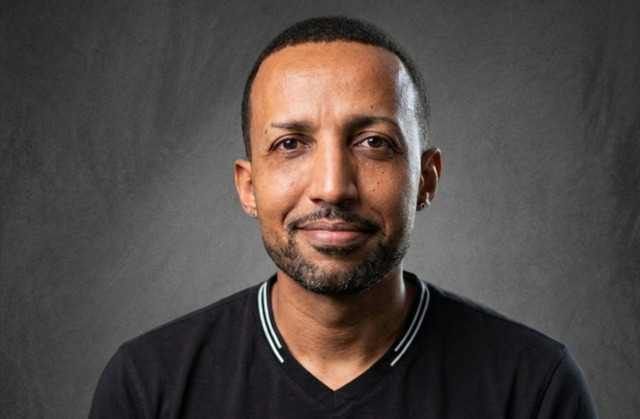
 Fasil Bizuneh — writer of “Hide the Light." (Courtesy photo)
Tadias Magazine
April 2026
Editor’s Note:
New York (TADIAS) — Ethiopian American writer Fasil Bizuneh brings a deeply personal voice to questions of memory, discipline, and inheritance. Born in Frankfurt, Germany, in 1980 after his parents fled Ethiopia in the 1970s, Fasil was raised in Indianapolis and went on to earn a degree in chemical engineering from Arizona State University. He later became a professional distance runner, including winning the U.S. 10 Mile Championship in 2010. Today, he lives in Hawaiʻi with his two children, where he teaches high school mathematics and science while continuing to write with a focus on family history, endurance, and the structures that shape a life.
In the essay that follows, “Hide the Light,” Fasil turns inward to tell the story of his mother, Eyerusalem, whose early adulthood unfolded under the shadow of violence during that tumultuous period. At the same time, the piece is inseparable from the journey of his father, Dr. Moges Bizuneh, whose life began in Harar under conditions of hardship that would define his lifelong commitment to education and medicine. As a child, Moges walked miles alone in search of schooling, later training in public health and going on to teach anatomy and physiology for decades in the United States. Together, Eyerusalem and Moges represent a generation shaped by upheaval, separation, and the difficult choices required to survive and rebuild.
Their story also intersects with a broader creative and familial legacy. Fasil’s uncle, artist Alemayehu Bizuneh, played a pivotal role in their journey to safety. His painting, The Grape Press, created in Germany in 1979 as a Lenten “hunger cloth,” became more than a work of art—it helped fund the flight that brought Fasil’s parents to Frankfurt, where their lives would begin again. Trained in Addis Ababa and Paris, Alemayehu’s work gained recognition across Europe, and this painting remains part of that enduring legacy.
“Hide the Light” is, at its core, a portrait of a young mother navigating fear, separation, and uncertainty. It is also a reflection on what two people built from nothing—across distance, time, and circumstance—and how those experiences continue to shape the next generation.
We are honored to share Fasil Bizuneh’s work with our readers.
Hide the Light
By Fasil Bizuneh
My mother was twenty-one years old.
It was two in the morning and the baby would not stop crying. The electricity worked but the lights stayed off. A single candle, low and shielded, threw just enough shadow to see by. Black curtains against the windows. Outside, Derg militia walked their routes. They had already taken the house once, commandeered it as an office, gone through every room. They knew whose house it was. They knew who her husband was. They knew where he was hiding.
She drew her son against her and fed him in the dark. Every night: hunger against silence. She was a new mother in a curtained room in Gondar. Her mother sat with her. Two women and a baby and a candle in a house the government had already claimed. When the baby slept, she slept. When he woke, she was already awake.
One morning she opened the door and found three bodies in the street. Armed guards stood over them. They were not there to investigate. They were there to ensure no one reclaimed the dead.
She went back inside.
She fed her son.
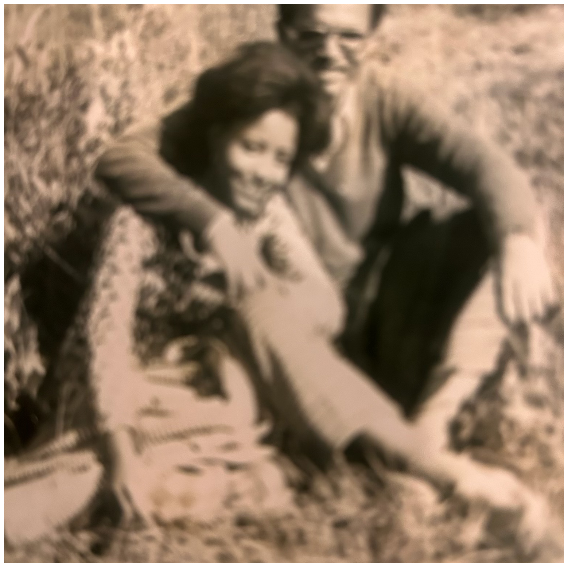
Eyerusalem and Moges, early years — before the upheaval that would separate them. (Courtesy photo)
Her husband was sixty miles away.
He had been in the countryside since October 1977, moving between villages, living with subsistence farmers who had agreed to shelter him at considerable risk to themselves. The clinic had no building. Tarps stretched between poles. The patients were resistance fighters who came in from the field with gunshot wounds and injuries that he could not properly treat. He performed minor surgeries. He debrided wounds, closed what could be closed, made decisions about what the body could survive without equipment that should have been there. He had trained at the Public Health College of Gondar. He worked with what the countryside provided.
Between fighters, he treated the farmers and their families. This was the arrangement: shelter and food in exchange for what he could do with his hands. The farmers fed him. He kept their children alive when he could.
One evening his host came home drunk and turned on the household maid. My father intervened. The farmer produced a gun.
My father relented.
He went back inside. That night, a drunk man with a gun had set the boundary.
He did not discuss it.
By April of 1978, she understood he was not coming back.
Eyerusalem left her baby. The journey would have killed him.
Amsalu would celebrate his second birthday with his grandmother, too young to remember his parents’ faces, only their absence.
It was the fall of 1979. My parents had found positions at a refugee clinic in Al Qadarif. They treated the sick, trained what staff they could, sent money back to Gondar when there was money to send. They wrote letters. They waited for letters in return.
One arrived with a photograph.
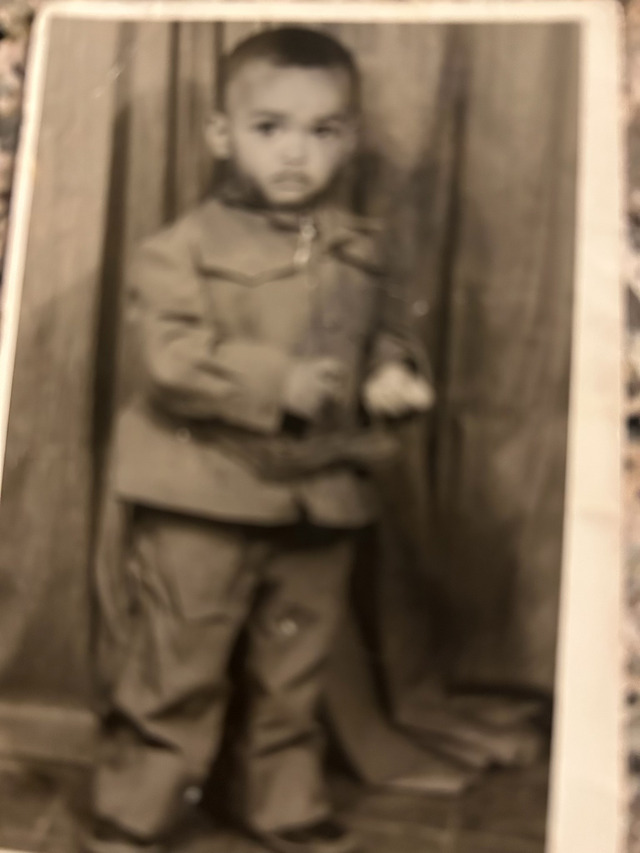
Amsalu at age three, photographed in Gondar and sent to his parents in Sudan. (Courtesy photo)
A boy, three years old, stood in front of a wooden door. His grandmother had dressed him in a small suit, jacket, trousers, shoes. He was holding something small. His face was serious in the way small children are serious when they do not yet know what the moment requires of them.
My parents looked at the photograph and did not know who he was.
They read the letter. Then they knew.
He was wearing new clothes. His grandmother had made sure of that. The boy who had been left behind at twenty-two months, the boy they had been feeding on money orders from a refugee camp, had become someone they needed a letter to identify.
In March of 1980, when my mother was seven months pregnant, they left. They crossed to Khartoum and boarded a plane.
The ticket was purchased by a painting.
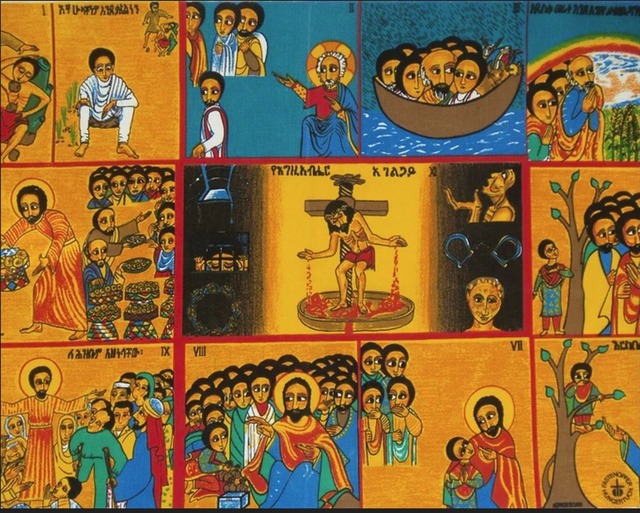
The Grape Press (1979), by Alemayehu Bizuneh — the painting that helped fund the family’s journey to Frankfurt. (Courtesy photo)
Alemayehu Bizuneh had been living in Frankfurt since 1976 on an artist's fellowship from the Catholic Church. My uncle had found his way to the Addis Ababa Arts Institute, then to Paris to study art, then to Frankfurt, where he was commissioned to create a painting. The church requested a nine-foot by five-foot Lenten hunger cloth to be hung between the nave and the altar for forty days, covering the sacred from view.
He called it The Grape Press. Eleven scenes. Suffering and what it asks. What waits on the other side of it. It was reproduced as postcards distributed across Europe. Screenprints sold. They are still being sold today.
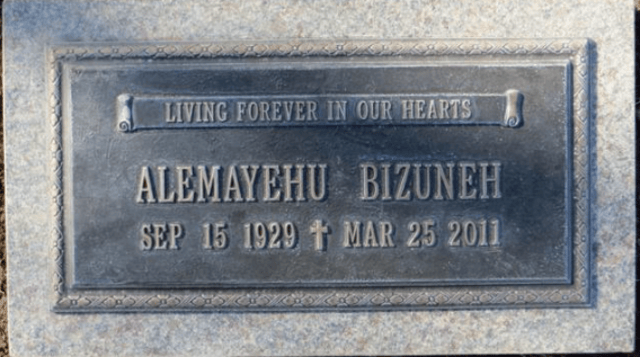
Alemayehu Bizuneh (1929– ), artist and brother — whose work became part of the family’s passage to safety. (Courtesy photo)
The commission paid for the flight.
My parents arrived in Frankfurt in March 1980. The refugee hotel housed families from Yemen, from Eastern Europe, from Russia. This was a community in transit, people between one life and the next, waiting for the door that would open into whatever came after.
On May 5, 1980, I was born. Alemayehu was there.
Later, when he visited the hotel, he found his brother and a woman holding a baby. The window was open. The curtains were drawn wide, letting in the afternoon light. My mother was feeding me.
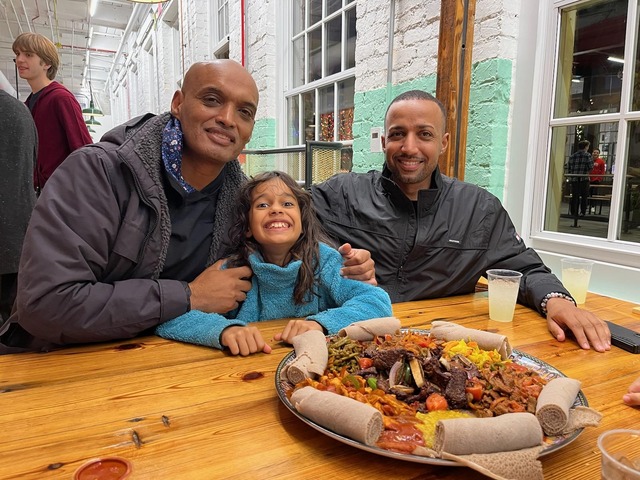
Charlotte, 2023 — three generations gathered, a continuation of the journey. (Courtesy photo)
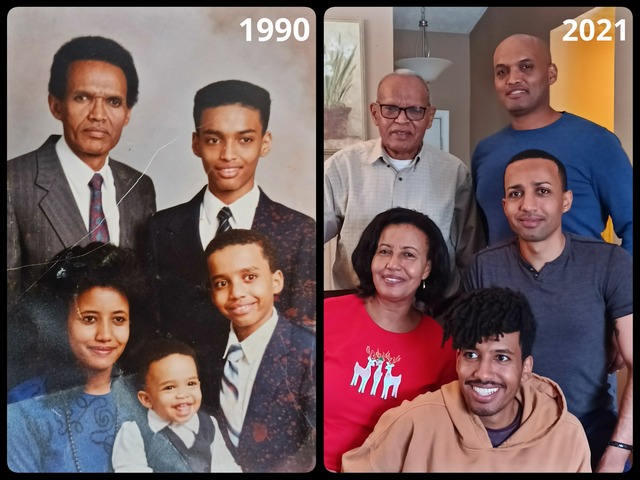
(Courtesy photo)
—
About the Author:
Fasil Bizuneh is a futures trader and high school mathematics teacher on the Kohala Coast of Hawaiʻi Island. He holds a degree in chemical engineering from Arizona State University and is a former U.S. national champion distance runner. He also holds a Hawaiʻi state spearfishing record and dives the reefs of North Kohala on a single breath. His writing examines mastery, discipline, and non-attachment in both markets and life. He is currently completing The Narrow Path and its companion volume, The Tip of the Spear.
Join the conversation on Instagram, X and Facebook.