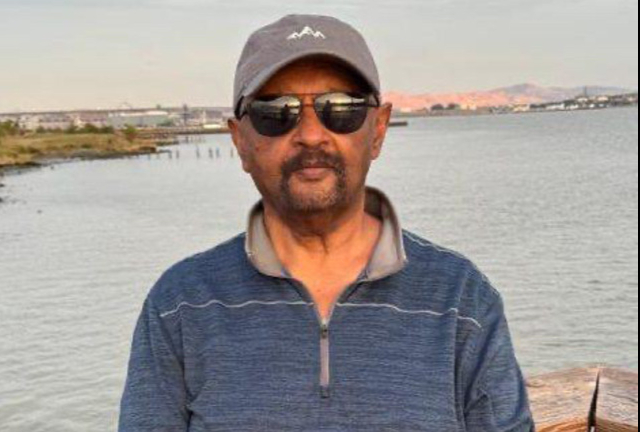
 Engineer Fesseha Atlaw, a pioneer in bringing Ethiopic script into the digital age. (Photo by Dr. Berhanu Temesgen)
Tadias Magazine
By Tadias Staff
February 2026
New York (TADIAS) — For more than four decades, engineer Fesseha Atlaw has played a foundational role in bringing Ethiopic script into the digital world. His early work — from designing fonts pixel by pixel to contributing to Unicode standardization — helped ensure that Amharic and other Ethiopic-based languages could exist on modern computers.
Today, artificial intelligence is reshaping how languages are processed, translated, and learned. As AI systems increasingly interact with historically underrepresented languages, new questions emerge about accuracy, cultural context, ownership, and digital ethics.
In this conversation, Fesseha reflects on the early days of Ethiopic computing, the evolution of language technologies, and what the AI era may mean for Ethiopian languages and their global communities.
Early Computing & Historical Perspective
TADIAS: When you first worked on bringing Ethiopic script into modern computing, what did you imagine the future might look like — and how does today’s AI moment compare?
Fesseha Atlaw: In those early days, more than 40 years ago, it was unimaginable to think where technology would be in 2026. It was even harder to imagine that computers would accommodate non-Latin scripts like Greek, Russian, Chinese, or Arabic — let alone Amharic and the Ethiopic script.
Early computer systems were designed almost exclusively for the Latin alphabet due to their origins in English-speaking countries. Non-Latin scripts were initially integrated through hacks and clever workarounds before global standards like Unicode emerged.
ASCII mapped English characters, numbers, and symbols to 7-bit numerical values (0–127). Later, 8-bit systems added another 128 slots, where developers inserted accented letters or entire scripts.
I designed Ethiopic fonts pixel by pixel and substituted them in place of Latin fonts. Even an 8×8 grid could not fully accommodate some Ethiopic characters.
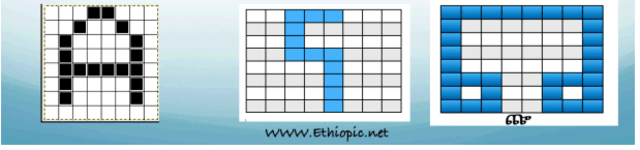
So I used “font extenders.” For example, assigning one space for ለ and another space for — to form ሉ, and similarly for ሊ, ሎ, etc. This workaround compensated for limited space before Unicode standardization.
Interestingly, this approach resembled the mechanical Amharic typewriter designed by Engineer Ayana Biru in the early 1930s, which used base characters and extensions.
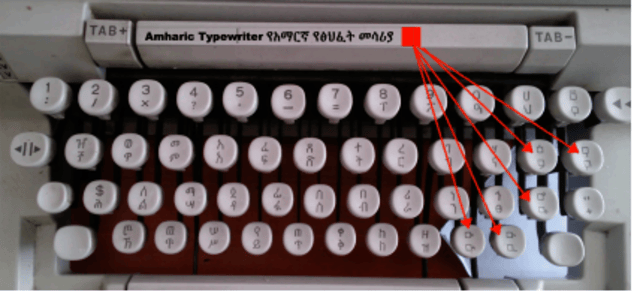
Even with extended ASCII (256 spaces), it was not enough to accommodate over 300 Ethiopic characters — now more than 400 when including additional Ethiopian languages.
When I began this work, operating systems were primitive DOS with no graphical interface or mouse. Typing in non-Latin scripts was unimaginable.
In 1989, Dr. Joseph Becker, a Xerox scientist, approached me to help include Amharic in a multilingual word processor Xerox was developing for Voice of America broadcasts.
My office at Hewlett-Packard in Palo Alto was near the Xerox Research Lab — the research center where the mouse-based graphical user interface was pioneered. Dr. Becker and I met there regularly to discuss how Ethiopic script could be incorporated into emerging computing systems.
It is worth noting that many of the foundational concepts behind modern graphical operating systems — including the mouse and window-based interfaces — originated in this Palo Alto research environment before later being commercialized by companies such as Apple and Microsoft.
Dr. Becker later formed a technical committee to address the inclusion of non-Latin scripts in computing systems. These early and somewhat fragmented efforts eventually led to the creation of the Unicode Consortium and the Unicode Standard in the 1990s.
Unicode assigns a unique numerical code to every character in every language, allowing multiple scripts to coexist seamlessly within the same document and across platforms without conflict.
Dr. Becker invited me to serve as a voting member of the Unicode Technical Consortium. I represented Hewlett-Packard alongside my own company, Dashen Engineering.
At that time, it was beyond our imagination that an artificial software engine would one day fully understand Amharic or Ethiopic-based languages within our lifetime.
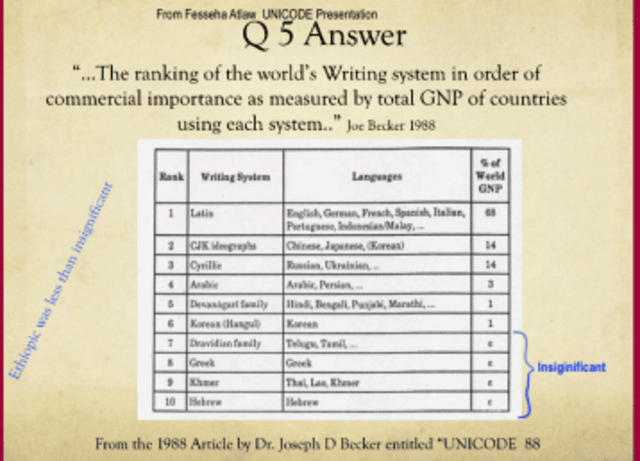
When the committee began prioritizing which languages to address first, Ethiopic was not among the top ten. (See figure below).
From Digitization to Artificial Intelligence
TADIAS: Do you see artificial intelligence as a continuation of early language computing — or a new chapter?
Fesseha: While I do not see a direct connection between Ethiopic computerization and today’s AI revolution, the script serves as infrastructure for AI engines. Digitizing Ethiopic laid the superhighway for all the AI tools to ride on.
Now, thanks to the early inclusion of the Ethiopic script in Unicode, Amharic and other Ethiopic-based languages are beneficiaries of this dynamic AI revolution.
Today, Unicode-enabled AI tools offer capabilities such as:
1. Automatic translation of any document — including websites — into Amharic.
2. Composition of an Amharic poem on virtually any subject.
3. The ability to compose and even perform Amharic songs, including generating original song lyrics.
4. The ability to converse in spoken Amharic with an AI system and receive a voice response in Amharic.
5. AI systems that can read aloud any Amharic or Ethiopic document — including emails, books, street signs, and even handwritten texts.
Amharic and other Ethiopian language models are rapidly evolving. Global models such as GPT-4 and DeepSeek have improved in translation and generation, though they still struggle with cultural context and names.
For example, AI has mistranslated names like:
አሸብር አንተነህ → “You are the terrorist”
ንጉሴ ተፈራ → “My king is feared”
አጥላው ወልደ ዮሐንስ → Atlaw son of John (Even when translating my own father’s book) :
The good news is that the most current models are learning to recognize these as proper names rather than literal phrases. They are also producing amazing translations and interpretations of unusual and deeply cultural Amharic sayings such as “አዛኝ ቅቤ አንጓች,” often providing two-page detailed analyses and unique interpretations through many of the current AI tools, like Gemini, DeepSeek, and GPT.
Some users feel frustrated with inaccuracies and complain to me. I see the glass as half full. Amharic AI accuracy may be around 80%, while other major languages like English reach about 95% or more. I tell them, “hold on — it is only a machine. It is not human. It is evolving.”
AI and Ethiopic Languages Today
TADIAS: How do Ethiopic languages fit into AI systems trained on massive datasets?
Fesseha: There are already several trained Amharic language models. AI systems can now interpret Ethiopian proverbs and “wax and gold” expressions (ሰምና ወርቅ).
To my surprise, AI provided multi-page interpretations of proverbs that exceeded my own understanding.
TADIAS: What are the biggest technical challenges now?
Fesseha: Most challenges are in the past. Generative AI is learning cultural norms, proverbs, and colloquial expressions at an alarming rate.
I say alarming because it can be unpredictable and at times unsettling.
TADIAS: What happens when AI does not fully understand cultural nuance?
Fesseha: That is the least of my worry. These systems are learning rapidly and mastering context — not perfectly, but impressively.
Opportunity, Risk & Cultural Meaning
TADIAS: Are there opportunities that excite you?
Fesseha: Digitizing Ethiopic script decades ago was exciting. That work created the infrastructure AI tools now travel on — rapidly and unstoppably.
As a person of faith, I believe technology must be approached with caution, with an acknowledgment of the Creator, who stands above and beyond all human knowledge.
My advice remains: Be careful when using AI and consuming AI-generated content.
TADIAS: What worries you about AI?
Fesseha: AI is artificial by definition. The technology is modeled on the most sophisticated computer ever created — the God-designed human brain and its neural network. At its core, AI is a constructed system; as its name suggests, its capabilities are artificial rather than human. It can blur the line between real and fake — even producing realistic videos of people saying things they never said. This affects all cultures and languages.
TADIAS: Does AI change how we relate to our written heritage?
Fesseha: Ethiopic script holds vast cultural and religious knowledge. AI now uses contextual learning to interpret Ethiopian content more deeply across languages. Recently, one of the newer AI tools analyzed the Book of Enoch — a rare text preserved in Ethiopia after being hidden for centuries.
Access, Youth & the Diaspora
TADIAS: Could AI make Ethiopian languages more accessible?
Fesseha: Yes. AI tools make learning Ethiopian languages more attractive, especially for diaspora youth.
These tools are patient, non-judgmental, and accessible.
Young people are also more skeptical of AI content, often warning parents when something is fake.
My own 85-year-old mother once described these technologies as “magic” — or even signs of the end times.
Ethics, Ownership & Power
TADIAS: Who should build AI tools for Ethiopic languages?
Fesseha: Anyone can build them — individuals, universities, companies. AI development cannot be stopped.
TADIAS: Who owns the knowledge used to train AI?
Fesseha: Models may be open-source or proprietary. Currently only about 20% are open source.
TADIAS: What would ethical AI development look like?
Fesseha: Ethical concerns apply equally across all languages. Many issues remain vague and difficult to control legally.
The Next Generation
TADIAS: What are young Ethiopian technologists, linguists, and designers doing now to ensure our languages are not left behind in the AI era?
Fesseha: AI-related activity among young Ethiopians — both inside the country and across the diaspora — is accelerating at a remarkable pace. The inclusion of the Ethiopic script in the Unicode Consortium standard has made it possible to use Ethiopic characters across modern software environments, enabling application development at nearly the same level as English and other Latin-based languages.
Our foundation, the Endrias Fesseha Atlaw Foundation (EFAW), sponsors an annual Ethiopic-based app development contest, and hundreds of applicants participate each year. This alone demonstrates that Ethiopic-based languages are not lagging behind. I continue to be impressed by the creativity and determination of young Ethiopians who are integrating Ethiopic script into AI-driven applications.
Here are a few examples of ongoing Ethiopic-centered AI initiatives:
Hasab.ai (Ethiopia) — a dynamic Ethiopian AI platform offering Ethiopic-language services including highly accurate speech-to-text transcription, text-to-speech, translation, meeting summaries, and AI interaction in Amharic and other Ethiopian languages.
Ehud AI (USA) — a web portal focused on Ethiopian users that provides content creators with multiple AI tools on a single platform.
MetaAppz.com (Canada) — offers Ethiopic-based games, translation tools, and language applications.
EthiopicApps.org — a hub for Ethiopic language tools and software.
Ethiopian Artificial Intelligence Institute (EAII) — a government-initiated effort positioning Ethiopia as a growing AI hub in Africa. Its initiatives include integrating Amharic into mobile apps, translation systems, and speech-to-text tools to improve accessibility in public services and banking.
Natural Language Processing (NLP) systems now work effectively with Amharic text, and synthesized speech can be nearly indistinguishable from a human voice. This capability was used in developing an Amharic add-on for OrCam assistive glasses that read text aloud for blind users.
These examples represent only a portion of the many AI initiatives leveraging Ethiopic script today.
Progress in AI understanding and engagement
Improvements are also evident in how AI tools interpret Ethiopic text and engage with cultural topics. A few years ago, when I asked an AI engine about the Ethiopian Lent season (የአቢይ ጾም), the response was: “I don’t feel comfortable discussing politics.” When I asked about ገብረ የሱስ, the response was: “I don’t feel comfortable discussing religion.”
Today, AI tools discuss religion and politics openly and with increasing nuance. Some systems can even generate sermons in multiple languages, including Amharic. More recently, AI has been used to analyze ancient Ethiopian biblical manuscripts written in Geʽez, assisting with authentication and translation of rare texts.
The digitization of Ethiopic script laid the groundwork for this progress, enabling AI systems to research, analyze, and interpret Ethiopia’s written heritage.
TADIAS: What should they focus on most urgently?
Fesseha: There is no urgent change needed — only caution.
Playing with AI for fun is like playing with matches; you do not know what might ignite.
Be careful. Stay aware. Use AI wisely.
TADIAS: Thank you, Fesseha.
Fesseha: አመሰግናለሁ፤ ታዲያሶች
—
To explore this work further, visit Ethiopic.net. Fesseha Atlaw welcomes inquiries at Fesseha@ethiopic.net.
Related:
Regarding The History of Ethiopic Computing by Fesseha Atlaw (Op-Ed)
How Ethiopic Script Was Introduced to Modern Computers: Interview with Fesseha Atlaw
Join the conversation on Instagram, X and Facebook.