




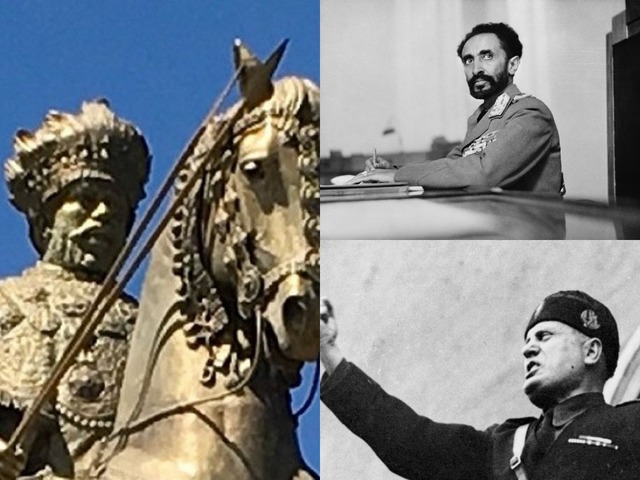
 From Menelik’s Victory at Adwa to Mussolini’s Invasion: Ethiopia’s History, Resistance, and the Stories Told by Western Media. (Photos: Wikimedia)
Tadias Magazine
March 2026
TADIAS — This March marks the 130th anniversary of the Battle of Adwa — a defining moment not only in Ethiopian history, but in global history. On March 1, 1896, Ethiopian forces under Emperor Menelik II defeated a European colonial army at the height of the Scramble for Africa. At a time when much of the continent was falling under foreign rule, Ethiopia stood firm.
Adwa was more than a battlefield victory. It disrupted a global narrative. It challenged the myth of European military inevitability and racial superiority. It offered a counterexample to the prevailing colonial logic of the late nineteenth century. And across Africa and the diaspora, it became a symbol of dignity, resistance, and sovereign agency.
Yet the way Adwa was reported in Western media tells a revealing story.
Adwa Through a Western Lens
When news of Italy’s defeat reached Europe and the United States, newspapers covered the shock. Headlines detailed Italian casualties and political fallout in Rome. But even in acknowledging the scale of the defeat, many reports centered European humiliation rather than Ethiopian achievement.
Ethiopia was often framed as an anomaly — a surprising exception — rather than a capable, organized power defending its territory. Coverage frequently reflected the racial assumptions of the era. The victory was treated as improbable, almost accidental, instead of the result of military strategy, diplomatic foresight, and national unity.
The lens mattered. Even in victory, Ethiopia’s accomplishments were filtered through the perspective of colonial assumptions, minimizing their true significance.
Mussolini’s Revenge
Four decades later, fascist Italy returned with unfinished business.
In 1935, under Benito Mussolini, Italy launched a full-scale invasion of Ethiopia. The campaign was framed domestically as a restoration of national pride — an attempt to avenge the humiliation of Adwa and build a new Roman empire in Africa.
This war differed dramatically from the 1896 conflict. Italian forces deployed overwhelming mechanized power, aerial bombardment, and chemical weapons, including mustard gas — in violation of international law. Civilian populations were targeted. Villages were destroyed. The brutality was systematic.
Ethiopia appealed to the League of Nations, exposing the fragility of collective security in the interwar period. Sanctions were weak and inconsistently enforced. Global powers hesitated. Geopolitics outweighed principle.
The Media and the Myth of “Civilization”
Western media coverage during the second invasion revealed another layer of bias.
Some outlets reported the aggression plainly. Others framed the war through language that echoed colonial ideology — describing Italy’s campaign as a “civilizing mission” or presenting Mussolini as a forceful modernizer restoring order. The human cost to Ethiopians often received less sustained attention than European diplomatic maneuvering.
In parts of the Western press, Mussolini was treated less as an aggressor violating international law and more as a strategic actor in a shifting European balance of power. Ethiopia’s resistance, meanwhile, was sometimes portrayed as futile or backward — a nation resisting “modernity.”
There were exceptions. Anti-fascist journalists and independent publications challenged these narratives and documented the atrocities. They recognized Ethiopia’s struggle as a moral test for the international community. But their voices competed with dominant geopolitical framing.
The pattern was clear: African sovereignty was too often evaluated through European interests.
Video: Full Amharic address of Emperor Haile Selassie to the League of Nations in 1936
Why Narrative Matters
Looking back from 130 years after Adwa, the contrast between battlefield reality and media framing offers a powerful lesson.
In 1896, Ethiopia shattered a colonial myth — yet coverage struggled to grant full recognition.
In 1935, Ethiopia faced fascist aggression — yet coverage often diluted the moral clarity of the invasion.
History is not shaped only by events. It is shaped by how those events are told.
For Ethiopia, Adwa remains a symbol of strategic unity and national confidence. The memory of the 1935 invasion remains a reminder of both resilience and betrayal. Together, they reveal not only the endurance of a nation, but also the importance of narrative sovereignty.
Today, in an era of instantaneous global media and renewed debates about bias, representation, and historical memory, revisiting these moments feels especially relevant. Whose perspective defines legitimacy? Whose suffering is centered? Whose strength is acknowledged?
Adwa was never simply about defeating an army. It was about defining dignity on Ethiopia’s own terms.
One hundred thirty years later, that work — of telling the story clearly and completely — continues.
—
Related from Tadias archives:
The Making of Global Adwa: By Professor Ayele Bekerie
Ethiopia: The Victory of Adwa, An Exemplary Triumph to the Rest of Africa
Adwa: Genesis of Unscrambled Africa
Join the conversation on Instagram, X and Facebook.