




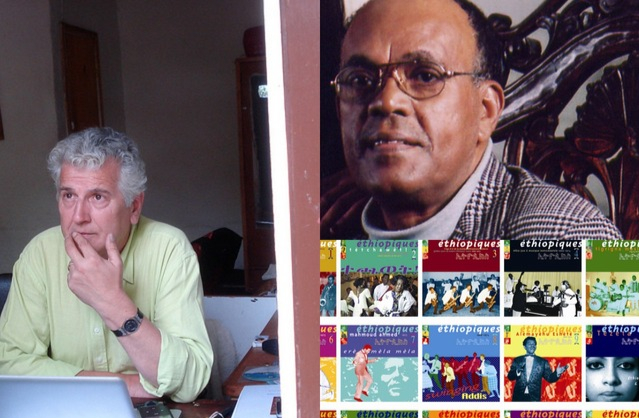
 Francis Falceto (left) and Amha Eshete (right), whose work helped shape the Ethiopiques series and preserve a defining era of modern Ethiopian music. (Photos: Tadias Archive)
Tadias Magazine
April 2026
As Ethiopiques Resurfaces, Revisiting Tadias Conversations with Francis Falceto and Amha Eshete
New York (TADIAS) — As renewed international media attention turns to the Ethiopiques series — with an upcoming release of new volumes and a relaunch celebrating past collaborations — and its enduring role in shaping global awareness of Ethiopian music, it offers a timely moment to revisit earlier conversations that helped document this story.
Produced by French musicologist Francis Falceto, Ethiopiques has played a defining role in introducing Ethiopia’s modern musical legacy to international audiences. Since its launch in the late 1990s, the series has compiled recordings from the 1960s and 1970s — many originally produced by Amha Eshete and others — bringing artists such as Mulatu Astatke and Mahmoud Ahmed to listeners around the world.
Tadias Archive: Early Conversations
In 2012, Tadias interviewed Falceto about the origins of Ethiopiques and the process behind bringing Ethiopian music to a wider audience. Reflecting on his early encounters with the music, Falceto emphasized the depth and originality of the recordings he discovered — and the importance of preserving them.
“It was a revelation,” Falceto told Tadias, describing his first exposure to Ethiopian records — a moment that would later lead to the creation of Ethiopiques
Recent activity surrounding new releases and public programs has once again highlighted the continued relevance of the series, more than two decades after it first introduced Ethiopia’s “golden age” of sound to global audiences.
The series itself, launched in 1997 with the support of Buda Musique, became a landmark archive of Ethiopian music from 1950 to 1975, carefully curated and restored for international audiences.
Amha Eshete’s Foundational Role
In a separate 2012 feature, Tadias also highlighted the work of Amha Eshete, whose label Amha Records produced many of the original recordings that would later appear in Ethiopiques.

Amha Eshete is the Founder of the trailblazing Ethiopian music label “Amha Records.” (Courtesy photo)
Between the late 1960s and early 1970s, Amha played a central role in documenting a generation of musicians during a vibrant cultural period in Addis Ababa. His recordings — created during a time of relative artistic openness before the political upheaval of 1974 — would later become the backbone of the Ethiopiques collection.
As Tadias noted at the time, Amha’s work was instrumental in shaping what is now widely recognized as the modern canon of Ethiopian music.
A Continuing Legacy
Today, as new volumes, performances, and discussions continue to bring Ethiopiques back into focus, the series remains more than a historical archive. It stands as an ongoing bridge between generations — connecting the original recordings of Addis Ababa’s music scene with new listeners across the world.
For Tadias, revisiting these earlier interviews underscores a simple but enduring truth: the global journey of Ethiopian music has always been shaped by both those who created it and those who worked to preserve and share it.
—-
Related Tadias Features:
Interview with Francis Falceto (2012)
The Legacy of Amha Eshete (2012)
Join the conversation on Instagram, X and Facebook.