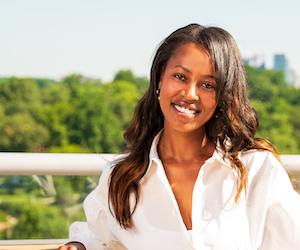


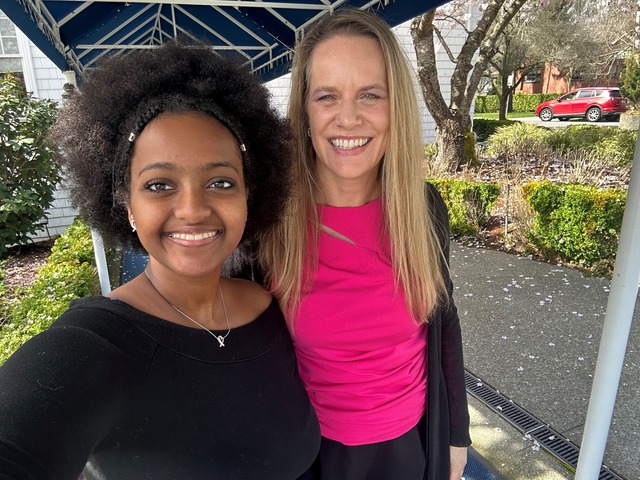
 Mother and daughter, Leyla and Ellenore Angelidis, at the Rotary Club of the University District in Seattle, Washington. (Courtesy photo)
Tadias Magazine
May 2026
In the final part of Tadias Magazine’s three-part series, OHBD founder Ellenore Angelidis reflects on how a family journey grew into a global literacy initiative publishing books in 15 Ethiopian languages while connecting children, communities, and cultures across Ethiopia and the diaspora.
New York (TADIAS) — In the concluding installment of Tadias Magazine’s series on Open Hearts Big Dreams (OHBD), founder Ellenore Angelidis shares the deeply personal story behind the organization’s evolution from a single library project in Bahir Dar into an international literacy movement rooted in Ethiopian languages, storytelling, and access to books. Based in Seattle and working closely with educators, writers, translators, Rotary partners, and communities across Ethiopia and the diaspora, OHBD has helped bring more than 600,000 books to young readers while championing the idea that every child deserves stories in their own heart language. In this conversation, Angelidis reflects on the journey, the challenges of building a “books economy,” and the larger vision driving the next chapter of the work.
TADIAS: The origin of Open Hearts Big Dreams is very personal. Can you share how it began?
In 2008, my husband and I expanded our family of four to a family of five when we welcomed our youngest and only daughter. She was born in Bahir Dar, Ethiopia. My husband is an immigrant from Greece and my parents are both immigrants too. We wanted to connect our daughter to her first country and culture. When she was a toddler, we started sharing more of what we learned about Ethiopia and started traveling back in 2010. She learned about the beauty but also the reality that not everyone had the same access to books and education that she did. She had a very visceral reaction saying, “That’s not fair, mama, you need to fix it.” This was a lightbulb moment for me. The inequity was so obvious that a toddler could see it (albeit a very precocious one- -I am a bit biased). And if you see an inequity and you can do something about it, you need to act.
The irony is she has no memory of that exchange which launched on us on this amazing journey. We started by building a library in her birth town and visited the site in 2011, the finished library in 2014 and the expanded library we funded in 2018. We also raised funds with our friends and family to support other literacy efforts in Ethiopia from 2011-2015. At that same time, I was an executive at Amazon given hard challenges and short times frames to come up with and execute solutions. I was frustrated that all the work we were doing with many others in Ethiopia wasn’t making a measurable difference that I could see.
So, in 2016, we decided to found a new organization to take the Amazon type approach of innovation, experimentation, speed, scale and apply it to white space challenges, like literacy, in Ethiopia. This was our second start or our re start and it’s when OHBD became its own not for profit. Late 2016, I was in my hometown of Denver and met up with our dear friend Jane Kurtz after an Ethiopian fundraising event. She had a few samples of the early bilingual books she and her sister Caroline were hoping would inspire others to create the children’s books needed in Ethiopia. This was another lightbulb moment for me, as I saw that if we redesigned and scaled this amazing idea, we could make a lasting and meaningful contribution.
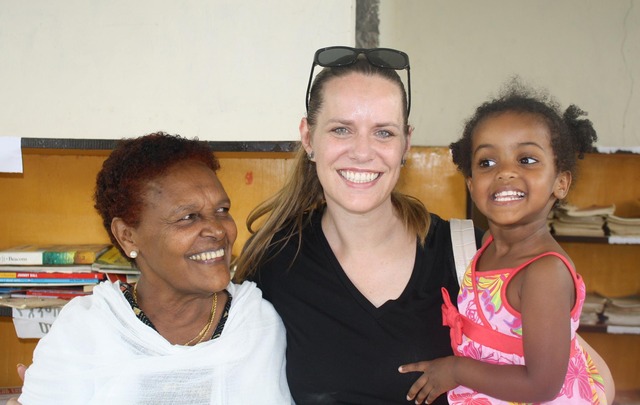
At Bahir Dar library in Ethiopia. (Courtesy photo)
TADIAS: The scope of the work has grown significantly. What has guided that expansion?
In addition to our personal goals of connecting our daughter to her birth country and make a positive contribution, our organizational true north is increasing the literacy rate in Ethiopia and encouraging a love of reading. We started with a goal to create the books needed for a small children’s library featuring familiar scenes and the top three heart languages. This felt huge as none of the mostly volunteer team had done anything like this. We hoped that would be enough. But as we created more books, we kept hearing, “How do I get them in Ethiopia.” We learned there was another gap. Most books are created for projects and not generally available in Ethiopia.
Then we knew we needed to do more. In 2021, we took a leap of faith with local printing when a supporter agreed to fund a large portion of our first printing to support their need for books for local projects. Printing is resource-intensive and logistically challenging. We chose print on demand globally to avoid this complexity. But when we realized it was a necessary part of reaching our true north, we started with a pilot and have been printing in country every year, high quality books. We have 100 Amharic, 35 Afaan Oromo and 10 Tigrinya so far. We did something most nonprofits do not, we funded the local printing ourselves and then offered them at our cost. Those funds go to support the project and more printing. We are also showing the world that Ethiopia can provide high quality printing. And if someone wants to start a reading room, they can get the books in a week: no shipping from another country, no customs; locally produced books.
Later that year we took another leap of faith; we started publishing smaller and endangered languages. We had created books for projects with smaller languages like Dizin and Tambarsa for in-country use but didn’t publish them to be available globally. Thanks to a chance meeting with the very compelling Oballa Oballa at a Helen Empower the Community event, Anuak language from the Gambella region became a focus. We saw then the power our books had to support language and culture preservation. We have since expanded to include 15 Ethiopian languages and extended an open invitation to any community who would like to help us add more.
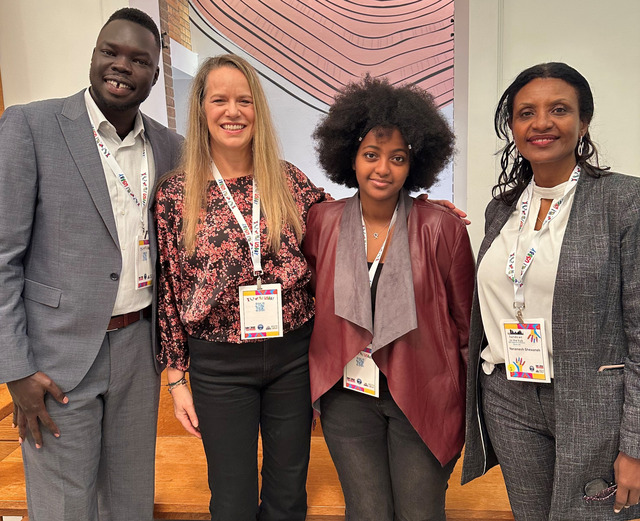
From left: Jekap Omod, lead of the OHBD Gambella Project; Ellenore and Leyla Angelidis; and Yenenesh Shewaneh, OHBD board member and writer based in the Washington, DC metro area, at the 2025 USBBY Conference in Boston. The conference, hosted by the United States Board on Books for Young People, centered on children’s literature as a mechanism for change and action. All four participants served as panelists, sharing their work in Ethiopia through OHBD books. (Courtesy photo)
Our creative lead Jane Kurtz won an IBBY iRead Reading Promoter Award that year honoring the two most impactful reading promoters globally for her decades of work in Ethiopia and most recently with OHBD. They were impressed that OHBD was tackling all parts of the challenge from creation, writing, illustration, design, quality translation, production and even local printing and distribution. We noticed Ethiopia wasn’t included in international children’s books forums like IBBY and major book fairs. We saw another gap we could fill so we sponsored and launched IBBY Ethiopia in 2023 and Ethiopian books, creators, and languages were recognized on that global stage for the first time in 2024.
While getting our locally printed books available in country was a great step, we saw that we needed to take a more active role in piloting a reading room model to make books available all over the country. We launched a few efforts that year in Gurage and Oromia. We knew we needed financial and logistical support to scale. I am a Rotarian, Ezra Teshome is my sponsor, and together we launched our first Rotary Reading Room in Metu in 2025 with Addis Abba Rotary Club and a second in Addis this year with Addis Ababa West Club. We are in the process of launching others in the coming months with a number of US and Ethiopian Clubs. We expect that effort to grow significantly to meet the goal to get our books all over Ethiopia in the next decade.
TADIAS: You’ve spoken about the need for a “books economy.” What does that mean?
This means there are all the pieces of an economic model relative to kids’ books is established in Ethiopia including creators, publishers, purchasers, individuals and organizations, and distributors.
Creators, like children’s book writers, illustrators and translators, need experience and training about what make a great children’s book to encourage imagination, critical thinking and a love of reading. Storybooks need to be required reading in schools and they need budgets to purchase. Publishers need to produce high quality books and distributors need to get them all over Ethiopia and globally in a way that allows them to survive and thrive. These books need to be copyrighted, required for awards, and able to generate value for the different contributors to become sustainable over time. We are working to create a pilot with all pieces to show what is possible and hopefully be a catalyst to make fast progress on developing a book economy for Ethiopia!
TADIAS: The work has also reached beyond Ethiopia through libraries and partnerships. How do you see that evolving?
What we learned is that the books we were creating for Ethiopian children in heart languages were much needed in the rest of the world too. Books from other parts of the world dominate in libraries and schools. Since our books are bilingual, high quality and available globally, they can meet those needs while helping the project become sustainable and show that this critical piece of the books’ economy, demand for books by and for Ethiopians, exists.
All children need to learn about the stories of their own cultures, mirror books, as well as learn about the stories of others, window books, to encourage different perspectives and empathy. As we meet a need globally, the funds from those book sales and licenses help us fund the literacy work in Ethiopia and growing our book catalog with new titles and languages.
TADIAS: What has been most meaningful for you personally?
On a personal level, getting to do this with my daughter who inspired the effort as a toddler before she had memories has been life-changing and seeing the power of our books to connect her and our family to Ethiopia has been incredibly meaningful. We have traveled the world, written books together, shared our triumphs and frustrations and truly became a team as well as mother and daughter. Our whole family is involved in different ways. My eldest son helped with early fundraising and some book production. My middle son is currently our production lead; my husband supports through sponsoring books, taking photos and videos, and providing some Greek translations. So many other family and friends help too including my mom who translated some of our books into her native Dutch.
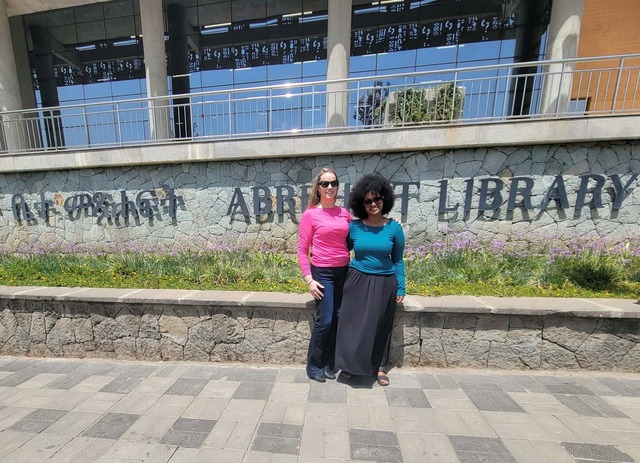
(Courtesy photo)
On a professional level, I am honored by all the people who believed in our mission and joined us with their trust, their talent and their treasure, when OHBD was just a crazy idea. If you want a reason to be hopeful, the group that continues to show up for kids in Ethiopia and around the globe is a shining example that ordinary people can truly do extraordinary things. Being able to take something from an idea and honestly a dream, and make it into something truly meaningful for so many people globally in a decade of effort, using everything I learned as a University of Chicago trained lawyer and long time Amazon executive, is truly humbling and motivating. My accidental social entrepreneur chapter as an unpaid volunteer is every bit as challenging as any professional role I have had before.
TADIAS: What’s next for Open Hearts Big Dreams?
In 2017, we set a bold goal of creating 200 quality early readers in three Ethiopian languages. We are now at 195 books with more than enough in the pipeline to exceed the 200 goals. And we publish in 15 Ethiopia languages as well as another 17 African and global languages.
Our next goal is to get our books in reading rooms all over Ethiopia through the power of Rotary and book promoters all over the world. We are currently also working with BookAid on 5 locations of a story books project ranging from Axum to Bahir Dar to the rural south and Gojjam. And as mentioned, we are working on a number of Rotary funded new reading rooms. We know if everyone helped us get books to their community, we could make fast progress.
Part of this next chapter of work is growing IBBY Ethiopia as a national chapter. OHBD launched and sponsors the current chapter. This participation allows books and reading promoters to be part of awards and reading activities globally. It is also designed to connect everyone in Ethiopia connected to children’s books together so that they can share best practices and combine forces for bigger positive impact.
We also have a goal to preserve all current Ethiopian languages in my lifetime or if we need more time Leyla’s.
Final words
We have a few measures of success beyond the traditional one. One is how many people and organizations we collaborate with or inspire. Another is whether our project is spreading hope and joy. Our project has reached every region of Ethiopia, printing and distributing more than 600,000 books in twelve Ethiopian languages in collaboration with amazing partners like Ethiopia Reads. Each region has embraced the books and contributed in different ways. One of our supporters’ calls this a peace project because it is way for the children of Ethiopia to learn about each other through stories in their own heart language. When we travel the world, people are excited to learn more about the country, stories and languages of Ethiopia. Leyla and I have learned so much that I can usually tell someone in Ethiopia or the Diaspora something about Ethiopia they didn’t know before, as hard as that might be to believe.
I would like to offer two final thoughts. First is a way to test if you are part of the solution or part of the problem. It’s simple. Ask yourself what are you doing to solve the problem. If it is nothing but complain about it, you are solidly part of the problem. If you are working at trying to make things better, you are part of the solution. You are not required to be successful. Trying is enough because your failed effort might be the motivation for the next person to try. This was the lesson toddler Leyla showed me and it stuck.
Second, I would like to give everyone the two things they need to do to be successful at anything from my diverse experience including this OHBD chapter! The first thing is to start. That is way harder than it seems. The second is to believe in what you are doing. If you truly believe, you will keep going no matter the obstacles and most people fail because they give up too quickly.
Our OHBD team is open to all. We need our global community to continue to grow and show up for kids to make this audacious dream of books for all the kids of Ethiopia in their heart language, which results in full literacy and a love of reading, a reality in our lifetime. We believe it is fully possible. We just need to want it enough and make the investments. The missing books are missing no more. Now the need is more achievable – with funds and distribution support. This is now true because a little girl recognized an inequity and challenged the adults in her life to do something about it.
—
For more information and to explore the books, visit:
OHBD Ready Set Go Books: https://ohbd-rsgbooks.com/
Open Hearts Big Dreams: https://openheartsbigdreams.org/
Related:
Open Hearts Big Dreams: Stories That Travel Across Languages and Generations
Open Hearts Big Dreams: Building a Reading Culture, One Book at a Time
Join the conversation on Instagram, X and Facebook.