



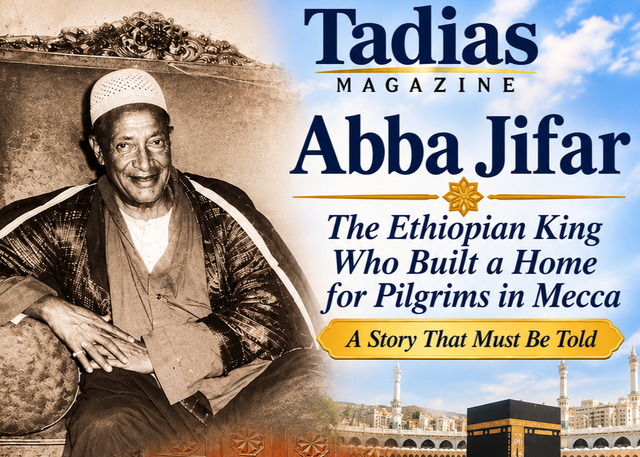
 A story of Ethiopian history, compassion, and a legacy that deserves to be remembered: The remarkable story of King Abba Jifar II of Jimma, who established a charitable endowment in Mecca—a gift that continues to serve pilgrims to this day. (Courtesy photos)
Tadias Magazine
By Emmanuel Mekuria
November 21, 2026
TADIAS – A story that must be told:
When you go to Mecca, you are not alone. Abba Jifar prepared a place for you.”
These are the words that stayed with me long after I finished speaking with Ababiya Nejib. They are the words of a descendant speaking about his ancestor, not with pride alone, but with a deep sense of responsibility. A responsibility to remember. A responsibility to tell. A responsibility to make sure that a story like this does not disappear from our memory.
I am writing this because some stories are too important to be forgotten. At a time when so much news about Ethiopia is marked by conflict and division, here is a story that deserves to be known—a story of generosity, faith, and a king who used his wealth to serve his people.
This is the story of Abba Jifar II, the king of Jimma, and the home he built in Mecca for Ethiopian pilgrims. I am telling it because Ababiya Nejib, a descendant of the king’s family and grandson of his sister, sat with me through many telephone conversations and shared what his family has carried for generations.
Abba Jifar II ruled the Kingdom of Jimma from 1878 to 1932. Under his leadership, Jimma became one of the most prosperous and influential kingdoms in the region. Wealth flowed through its markets, with coffee, ivory, and other goods traded across the Red Sea and beyond. Jimma was also a center of commerce, scholarship, and Islamic learning.
But Abba Jifar was not content simply to accumulate wealth. He was a devout Muslim who understood that leadership carried responsibility. His kingdom’s prosperity was not meant to be hoarded; it was meant to serve.
Ababiya Nejib told me that his great-uncle was not a king who sat far removed from the struggles of his people. He listened. He paid attention. When he heard about the hardships Ethiopian pilgrims faced, he did not simply express sympathy. He acted.
In those days, the pilgrimage to Mecca was a journey of extraordinary hardship. Ethiopian Muslims traveled for months on foot, by mule, and by ship from the port of Massawa. They carried their own food, medicine, and supplies. Many sold everything they owned just to make the journey.
When they finally arrived in Mecca, exhausted and far from home, they often had nowhere to stay.
Imagine it for a moment: You have walked for months across deserts and mountains. You have spent your life savings. You are in the holiest city of Islam, surrounded by pilgrims from every nation, but you have no bed, no roof, and no place to rest. You sleep in the streets. You depend on the charity of strangers.
This was the reality for many Ethiopian pilgrims. When word of their suffering reached Abba Jifar in Jimma, he did not simply feel sympathy. He acted.
Ababiya Nejib remembers hearing how pilgrims would return to Jimma and tell the king about their hardships. They spoke of sleeping in the streets of Mecca, of being hungry and alone in a foreign land.
“My great-uncle listened,” Ababiya Nejib told me. “He did not simply nod with sympathy. He acted.”
Abba Jifar sent a delegation to Mecca with a fortune in silver—reportedly around 75,000 Maria Theresa thalers. He instructed his envoys to purchase land and build proper lodging for Ethiopian pilgrims. From Jimma itself, he sent craftsmen and building materials, including long nails and ironwork produced in local workshops.
What they built was a two-story house with 37 rooms, close to the sacred sites. More importantly, Abba Jifar established it as a waqf, a permanent Islamic charitable endowment. This meant the property was dedicated to charitable purposes and could not be sold or used for private profit. It belonged to God and to the pilgrims.
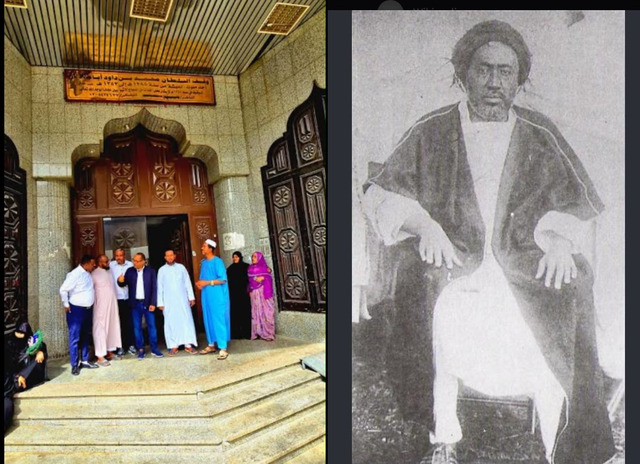
Nearly a century after Abba Jifar II established a home for Ethiopian pilgrims in Mecca, his vision of service continues. Originally built as a two-story house with 37 rooms, the property was established as a permanent charitable endowment, ensuring that Ethiopian pilgrims—regardless of their means—would always have a place to stay. Today, the endowment continues to accommodate hundreds of pilgrims, preserving the legacy of a king who believed that true wealth lies in giving. (Courtesy photos)
There was one rule that reflected the king’s character: no pilgrim would ever be asked to pay. The rich and the poor, the merchant and the farmer, were all welcome. The door was open to every Ethiopian Muslim who arrived in Mecca.
Ababiya Nejib told me something that I have not stopped thinking about. He said that when he walks through those rooms in Mecca today, and meets pilgrims from Jimma, Harar, and Wollo who have slept there without paying a single coin, he wants to tell them: Thank Abba Jifar. Thank the king who remembered you before you were born.
This story matters because it reminds us of who we are as a people.
In a world that often focuses on what divides us, Abba Jifar’s story is a bridge. It connects Ethiopia to the wider Islamic world. It connects the Kingdom of Jimma to the holy cities of Mecca and Medina. And it connects a king’s wealth to a poor pilgrim’s place of rest.
It also reminds us that Ethiopia has never been isolated from the rest of the world. Our history is woven into the history of Islam, trade, pilgrimage, and scholarship. Abba Jifar was not simply a local king; he was a leader whose vision extended far beyond the borders of his kingdom.
The original building in Mecca was eventually relocated as the city expanded. But the waqf survived. Today, it stands as a five-story building in the Al-Utaybiyyah district, still accommodating around 700 pilgrims, still managed by a committee of Ethiopian Oromo Muslims, and still led by a descendant of Abba Jifar’s family.
Think about that. Nearly a century after the king’s death, his gift is still serving its purpose. Pilgrims who were not yet born when Abba Jifar died are sleeping under his roof, eating in its rooms, and resting before they stand before the Kaaba.
Abba Jifar II died in 1932. His kingdom was subsequently incorporated into the Ethiopian Empire. Empires rise and fall. Borders change. Governments come and go.
But a waqf endures.
The home he built in Mecca is more than a building. It is a statement of values. It says: We are a people who care for one another. It says: Our faith is not just words, but action. It says: A leader’s greatness is measured not by what he takes, but by what he gives.
Ababiya Nejib told me that it saddens him that many Ethiopians—even many Muslims—do not know this history. They do not know that an Ethiopian king from the Kingdom of Jimma built a home for pilgrims in the holiest city of Islam. They do not know that this home still exists, still serves, and still carries his family’s legacy.
I am writing this because I believe every Ethiopian should know this story. Not just Ethiopian Muslims. Not just Oromos. Not just people from Jimma. Every Ethiopian.
Because this is a story of national pride. It is a story of African dignity—an Ethiopian king establishing a lasting institution in the holy city of Mecca at a time when much of Africa was under colonial rule. It is a story of faith in action.
And it is a story of hope.
At a time when so much seems broken, here is something that was built and has endured. Here is a gift that keeps giving. Here is a king who is remembered not for his conquests, but for his compassion.
Abba Jifar built a home for strangers in a foreign land. And in doing so, he built a bridge between Ethiopia and the Muslim world that still stands today.
This story deserves to be told. It deserves to be shared. It deserves to be remembered.
Because when we know stories like this, we know who we truly are.
And so I return to where I began—to the words of Ababiya Nejib, the grandson of the king’s sister and keeper of this family memory:
“When you go to Mecca, you are not alone. Abba Jifar prepared a place for you.”
May we never forget.
In memory of Abba Jifar II, King of Jimma, who understood that the greatest wealth is what we give away.
–
About the Author:
Emmanuel Mekuria is a contributor to Tadias and is based in Ethiopia.
Related:
Endalkachew Makonnen: Ethiopia’s Prime Minister and a Legacy Interrupted
Join the conversation on X and Facebook.